$50,000 in EMV. Impressive number. But what does it actually mean?
Earned media value, or EMV, estimates what you would have paid in advertising to get exposure comparable to what content about your brand generated.
A creator posts a story, a Reel or a post on their account. People see it organically. You count those views, then ask one question: how much would Meta, TikTok or Google have charged me for the same exposure?
It’s an estimate: nobody is going to pay you that amount. But it puts a financial order of magnitude on partnerships that don’t go through an ad platform.
How do you calculate EMV? Let’s start simple.
To put a value on impressions, the formula is:
EMV = number of impressions ÷ 1,000 × CPM
CPM is the cost per thousand ad impressions. An impression is one display: the same person can generate several.
Your campaign gets 100,000 impressions. If buying a thousand comparable impressions costs you $10 in advertising, your EMV is 100,000 ÷ 1,000 × $10 = $1,000.
That’s it. You estimate you would have had to spend $1,000 on ad delivery to get that exposure.
The real question is which CPM you pick. Use the one from your comparable campaigns: same network, same format, same country, same audience. A CPM picked at random gives you an equally random EMV.
Example with Instagram stories
You work with 5 creators. Each one posts 1 story about your brand, viewed 15,000 times on average, by a mostly American audience.
- Impressions: 5 × 15,000 = 75,000
- US benchmark CPM (Facebook Ads, e-commerce): $16.08
- EMV: 75,000 ÷ 1,000 × $16.08 = $1,206
The math is easy. The hard part is getting the numbers: a story disappears from the profile after 24 hours. If nobody saved it or asked the creator for its stats, the result becomes hard to back up.
Calculate your earned media value
Enter your impressions, then pick a benchmark CPM or enter your own. Benchmarks are in US dollars; your own CPM can be entered in its own currency. To reproduce the example above, enter 75,000 impressions and choose the United States.
Watch out for wrong calculations, even at Shopify
While checking EMV articles and calculators, we found a few surprises. Examples spotted on October 23, 2026, still online on November 4, 2026.
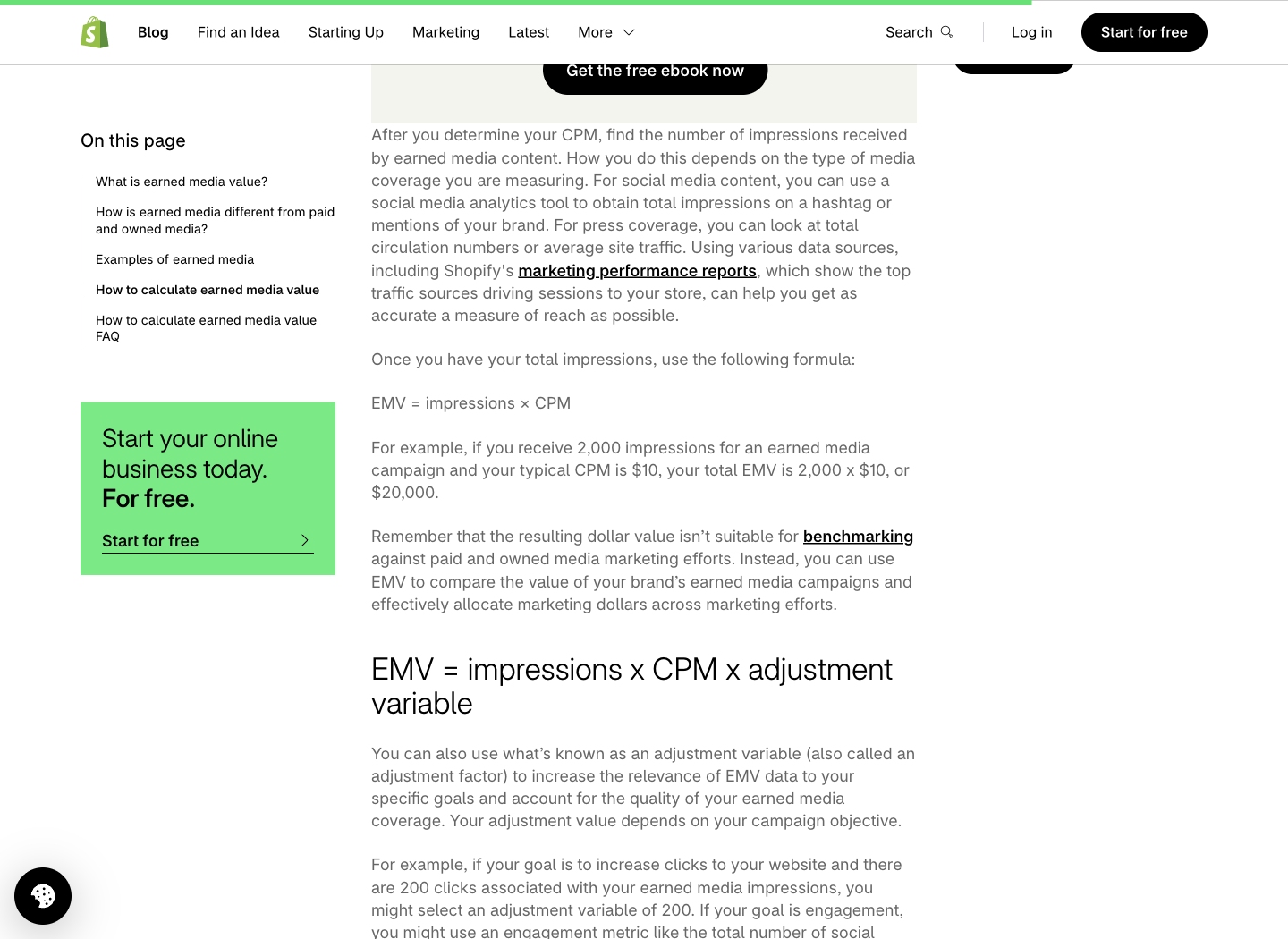
Shopify: $20,000 instead of $20. The article multiplies 2,000 impressions by a $10 CPM. It forgets to divide by a thousand. Result: a value 1,000 times too high. The correct math is 2,000 ÷ 1,000 × 10 = $20. See the Shopify example.
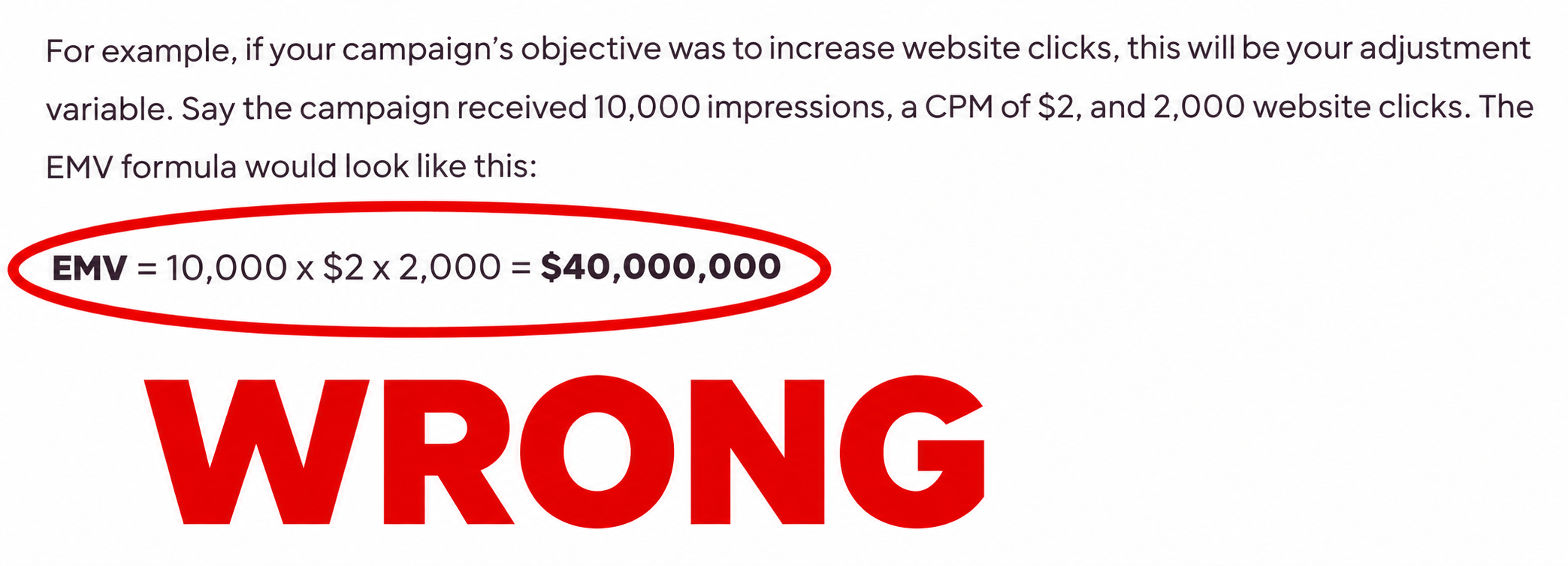
Metricool: $40 million for 10,000 impressions. The example multiplies impressions by a $2 CPM, then by 2,000 clicks. The division by a thousand is missing, and then multiplying by the number of clicks doesn’t produce a coherent ad cost. With that CPM, the exposure alone is worth $20. To value clicks separately, you’d need a cost per click. See the Metricool example.
The 30-second test
Before trusting a calculator, enter 1,000 impressions and a CPM of 10. The result should be 10. If it shows 10,000, the division by a thousand was forgotten.
Then ask where the CPM comes from. A tool that cites neither its source nor its time period is asking you to take its word for it. Our calculator shows the full formula and the source under every result: you can redo the math by hand.
What about likes, comments and shares?
Some tools put a price on them too. There’s no universal rate.
For Instagram, DemandBird shows $0.05 per like and $0.30 per comment. PostEverywhere uses $0.15 and $1.50. For the same comment, the value is five times higher.
These are valuation grids. They don’t prove you would actually have paid that price in advertising.
And watch the totals: impressions bought through an ad can already generate likes and comments. Systematically adding a price for every interaction risks counting part of the value twice.
Ask for the formula, the rates used and where they come from. A dollar figure with two decimals can still rest on a rough approximation.
Can you add the cost of creating the content?
We get the idea. A creator brings you visibility, but they also produce a video, photos, an edit. Getting comparable content produced would cost money.
So you can present two lines:
- Exposure value: $1,000 in EMV.
- Estimated production value: $300 for comparable content.
That’s $1,300 in estimated value, media + creation. But calling the whole amount “EMV” mixes two things. In the media-buying-equivalent sense, EMV here is still $1,000.
The $300 is an assumption you need to justify. And if you plan to reuse the content, make sure you have the rights. A video posted by a creator doesn’t automatically become your ad.
A good EMV doesn’t prove the campaign was profitable
A campaign can generate lots of visibility and very few sales. EMV measures an advertising equivalent; financial ROI requires looking at the margin generated and the campaign’s costs.
Many teams compare EMV to the campaign’s cost. Back to the stories example: $1,206 in EMV for $900 spent, or about $1.34 of media equivalent per dollar invested. This ratio is useful for comparing two campaigns measured the same way. It’s still not ROI: no sales go into the calculation.
To compare your campaigns, keep the same method and make your assumptions visible. You’ll be able to explain your result without having to blindly trust a calculator.
With Story Story, you can automatically save your creators’ stories and find their metrics in your reports. That data is where a useful calculation starts.
EMV frequently asked questions
What is a good EMV?
There’s no universal threshold. EMV depends on the volume of impressions and the CPM you use: with our benchmarks, the same campaign is worth more than twice as much at the US CPM as at the French CPM. Compare it from one campaign to the next using the same method instead, or relate it to the campaign’s cost.
Should you use impressions or reach?
Impressions. CPM is a price per thousand displays, not per thousand people. Multiplying reach by a CPM underestimates EMV. On Instagram, the metric is now called “views”: like impressions, it counts repeat displays.
Are EMV and AVE the same thing?
AVE (advertising value equivalency) comes from public relations: it values an article at the price of the equivalent ad space. EMV applies the same logic to social media. The Barcelona Principles, adopted by the PR profession, advise against AVE as a measure of the value of communication. The same caution applies to EMV: it’s an order of magnitude, not an outcome.
Why are the benchmark CPMs in dollars?
Our sources publish their benchmarks in US dollars. We show them as they are, so we don’t add an exchange-rate assumption. If you know your CPM in another currency, enter it directly in the calculator.
How do you get a creator’s story impressions?
Ask them for a screenshot of each story’s stats, and keep a copy of the stories themselves: they disappear from the profile after 24 hours. Story Story automatically saves the stories of the accounts you follow, so you keep proof of every post.
